
Letchworth Village
In the midst of New York’s Ramapo Mountains amongst the rolling hills of Rockland County, lies the bucolic hamlet of Thiells. It was the perfect spot for the president of the New York State Board of Charities William Pryor Letchworth to conceive of his new model of progressive care: a self-sufficient village of working farm cottages that would give mentally disabled patients a more humane lifestyle.

In the midst of New York’s Ramapo Mountains amongst the rolling hills of Rockland County, lies the bucolic hamlet of Thiells. It was the perfect spot for the president of the New York State Board of Charities William Pryor Letchworth to conceive of his new model of progressive care: a self-sufficient village of working farm cottages that would give mentally disabled patients a more humane lifestyle. This “community within a community” was a departure from the high-rise asylums and overcrowded almshouses which had become the standard of care for the mentally ill at the time. In 1907, New York State approved Letchworth’s plan and acquired 2,300 acres in Thiells. Construction was completed in 1911. Modeled after Monticello, Letchworth Village’s neoclassical fieldstone buildings afforded abundant sunlight to help aid the treatment of the developmentally disabled.
At the time of its opening, patients were categorized into one of three categories of feeblemindedness: idiot, imbecile, and moron. Based on their functionalities, patients helped farm, cook, sew, and care for livestock. Under the direction of superintendent Dr. Charles Sherman Little, research was conducted into the cause of mental retardation. The Village also became the testing site for the first polio vaccine. After trying it on himself, immunologist Hilary Koprowski administered the vaccine to 20 child patients, 17 of which developed antibodies to the disease.


By the 1940s, Letchworth Village nearly doubled its 3,000-patient threshold, yet new arrivals kept coming in from New York City, overwhelming the staff. It was the same time when a photojournalist named Irving Haberman released photographs of naked patients sleeping on floor mattresses. Many of them appeared to be malnourished. It became clear that the well-intentioned vision of Letchworth Village had taken a dramatic turn. In 1972, Geraldo Rivera’s ABC News exposé, Willowbrook: The Last Great Disgrace, shined a light on the decrepit conditions due to underfunding at Willowbrook State School and Letchworth Village. In the wake of the Rivera report, hospitals all around the country began the long, slow process of deinstitutionalization. Letchworth would move its residents to group homes while cutting down admissions before closing for good in 1996.
Today, many of the buildings still sit abandoned on the hospital grounds. A few miles away, Old Letchworth Village Cemetery serves as a stark reminder of what went wrong. T-shaped markers with only serial numbers, mark the resting place of those who lost their lives at the hospital. State agencies funded the installation of a permanent plaque inscribed with the names of the patients along with a resounding epitaph: “To Those Who Shall Not Be Forgotten.”

Sources
Almazan, S. (2018, June 14). From Shining Utopia to Terrifying Asylum: The Chilling Story Behind New York’s Letchworth Village. The Lineup Online.
https://the-line-up.com/letchworth-village
Ellis, W. (2012, August 5). Legend Tripping in Letchworth Village. AbandonedNYC Online
https://abandonednyc.com/2012/08/05/legend-tripping-in-letchworth-village/
Levine, D. The Real History of Letchworth Village. Hudson Valley Magazine Online.
https://hvmag.com/life-style/history/the-real-history-of-letchworth-village/
The Fire that Birthed Skull Silo
Around 5:30 am on May 2, 2006, a mysterious 10-alarm fire broke out at the Greenpoint Terminal Market in Brooklyn. Clouds of gray smoke stretched across the East River all the way to the West Side of Manhattan. It took 400 firefighters 36 hours and nine million gallons of water to fully extinguish the blaze, making it the most extensive operation by the FDNY since 9/ 11. It is widely speculated that the fire was a result of arson by the developer of the property. This building is one of the few remains of the historic waterfront.
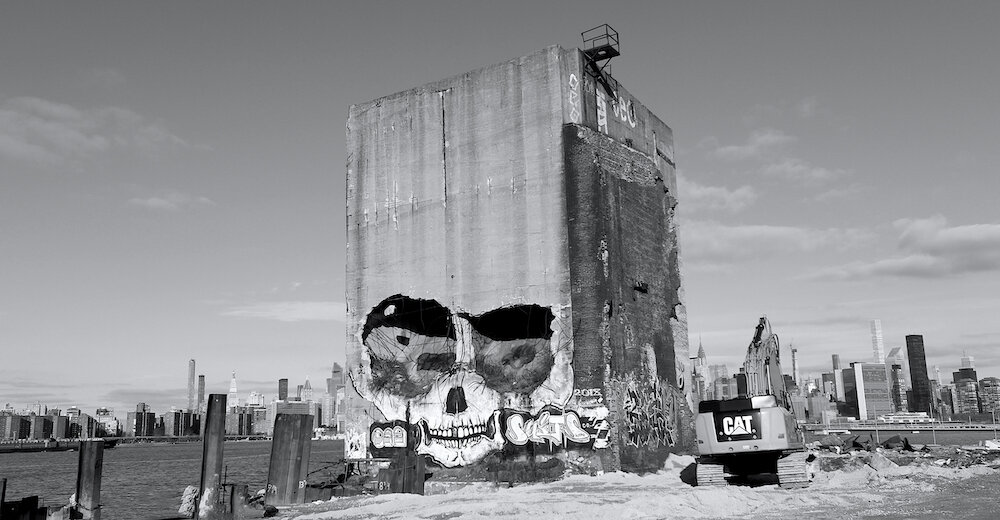
Street art has been alive in New York for decades. Although the very definition of street art is as amorphous as the very structures that artists use as their canvas, the urban environment of the City serves as a breeding ground and creative stimulus for renegade creators. And although the art on Brooklyn’s skull silo popped up sometime in 2017, its story begins back in 2006 when a 10-alarm fire ripped through the Greenpoint Terminal Market, thus spawning the greatest operation by the FDNY since 9/11. The fire would rage for some 36 hours before leaving a smoldering heap of brick and a couple of ravaged buildings including a silo-like structure with two massive holes gouged from it’s south side.
2005 was a record year for the Fire Department of New York. According to the Uniformed Firefighters Association, the FDNY saw a “50% increase in ‘greater blazes’ (two alarms or more) throughout the year.” At that time, 2005 was declared as the single busiest year in the history of the FDNY with a staggering 485,702 calls answered, beating out 1977’s record of 459,567. The market blaze which gave birth to skull silo, was one of the many suspicious fires that started in Brooklyn in late 2005. From December 7, 2005 to February 2006, ten such arson-suspected fires erupted along the Pacific Street Corridor in Prospect Heights. What’s even more striking was the proximity of several of the fires: 1033, 1084, 1162, 1198, and 1140 Pacific. The other fires occurred at 530 and 600 St. Marks Avenue along with two more fires at 461 and 658 Park Place, with another at 683 Dean Street nearby. Months later, Mark Jacobson of NY Magazine so aptly stated that 2006 was very much a ‘burning season.’ The Greenpoint Terminal Market fire too had suspicious origins. And for the firefighters of Brooklyn, the true test of their experience was yet to come.
Shortly after 5:30 am on May 2, 2006, smoke began billowing from 2 Noble Street, a dilapidated brick warehouse which was part of the greater Greenpoint Terminal Market situated on the East River. Engine 238 and Ladder 106 dispatched from Greenpoint Avenue and rushed down Noble to the scene. The firefighters en route knew that that the terminal buildings had been abandoned for some time and that freeing any squatters or vagrants would be the top priority. Upon entering the warehouse, the 20 firefighters where horrified to see that the three-story structure they entered was riddled with holes in the roof and walls which were built with 19th-century heavy timber. The cavernous rooms were piled high with old bundles of rope, cotton rags from the rope making process, and leftover merchandise from back when the terminal market was a full-fledged business. It was the perfect tinderbox.
The Greenpoint Terminal Market played an important part in American industrial history at the turn of the century. The market buildings dated back to 1890 and were built by the American Manufacturing Company which happened to be the largest rope manufacturer in the United States. By the 1980s, with the buildings of the American Manufacturing Company long gone, squatters, drifters, and feral dogs and cats had occupied the space.
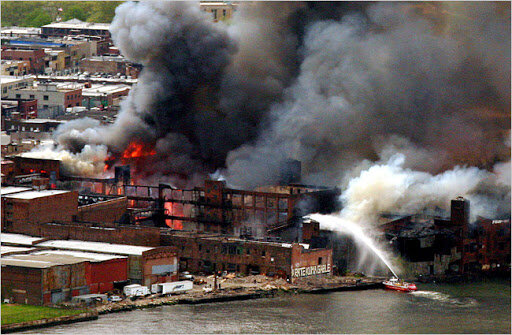
Courtesy of AP News
At approximately 5:44 am, a second alarm was transmitted to call for additional units to the scene. Shortly after, Engines 258, 211, 206, 207, and Ladder 128 and 119 arrived. Marine Unit 6, a 52-foot fireboat situated itself on the waterside of 2 Noble St., preparing to unleash its dual pump hoses – each capable of spraying an enfilade of 5,000 gallons of water per minute. Fifteen minutes later the fire began to spread east. For the firefighters already on the scene, the reality of the situation was clear; the building’s flammable contents and the air pouring in from its many broken windows and shoddy roof were acting as a natural accelerant. At 6:00 am, FDNY Operations Chief Sal Cassano, who would later serve as the New York City Fire Commissioner under Mayor Bloomberg, gave the order to pull out and set up for an exterior attack. A third alarm was dispatched.
Inside 2 Noble St., the conflagration became so hot that it began to generate its own wind, pushing the flames east, but also to the south, where there were more abandoned warehouses. The chiefs on scene worried that the fire might jump south across Oak Street to a new cluster of buildings. A fourth alarm brought in Engines 271, 325, 291, and 226 and Ladders 102 and 116. Units on the ground immediately opened a new front behind the building on Oak. Making its way down Oak Street was Tower Ladder 119, a 95-foot-tall apparatus with a boom and bucket capable of streaming 1,000 gallons per minute. It was looking to get as close as it could to the blaze however the towering truck encountered a second-story brick overpass that connected the main complex on Oak to the three buildings to the south. At that point, the fire was giving off such heat that a building south of Oak, ignited. By 6:30 am, the heat and spreading flames forced a fifth alarm with all units retreating back east toward West Street.
The general term “multiple-alarm fire” is a short way of indicating that a fire is severe enough to warrant additional units beyond the first dispatch. The common misconception behind multiple-alarm fires - a five-alarm fire for example - is that five firehouses responded to the call. This is not the case. Subsequent alarms beyond the first, are calls made by the chief on scene for additional units (usually an engine, ladder, or rescue truck) because the fire has become so out of control that more resources are needed to help combat it. The Greenpoint Terminal Market fire ended up dispatching 10 alarms, drawing some 80 different units from Brooklyn, Queens, and Manhattan, to the scene. In cases like this, alarms of 10 or more, requesting units from outside jurisdictions, are rare but not unheard of.
In 1995, a fire began on the ninth floor of the Clark Building, part of a complex of buildings forming the St. George Hotel in Brooklyn Heights. The initial dispatch brought the first arriving companies to an entirely different building allowing the fire to grow rapidly out of control. It would take 16 different alarms and more than 700 firefighters operating over 100 pieces of firefighting apparatuses to stop the inferno. Tangentially, the fires of the North and South Tower during the September 11th attacks were so out of control and out of reach, that they drew every available resource the FDNY could relinquish to the point where the on-scene Incident Command Post stopped counting alarms.
Around 8:15 am, while the units were retreating, 2 Noble St. collapsed, followed by nine other buildings throughout the complex. It was after the implosions that the fire finally began to settle. Officially, the inferno would not be considered under control until 5:11 pm on Wednesday, 1 day, 11 hrs and 36 minutes and some 400 firefighters later.
Upon investigation, initial attention turned to a 59-year-old Polish immigrant named Leszek Kuczera who was reportedly burning insulation off of wires for scrap metal. Kuczera, who confessed to the crime, spoke little English and was hungover the morning of his interrogation, later rescinded his confession and accepted a no-contest plea. The more damning culprit behind the Greenpoint Terminal Market fire is believed to be the owner and property developer, Joshua Guttman. Guttman had a $420 million deal to sell the complex only to see it fall through. During negotiations, the Municipal Art Society was pursuing landmark status for the entire terminal market complex. Had they succeeded, development of the Greenpoint Terminal Market would have been greatly restricted. The $420 million question was if arson had been used to quickly clear the land. Today, it is unclear what the future of the Greenpoint Terminal Market is. Like much of Brooklyn's industrial waterfront, it may soon be demolished and turned into luxury condominiums.
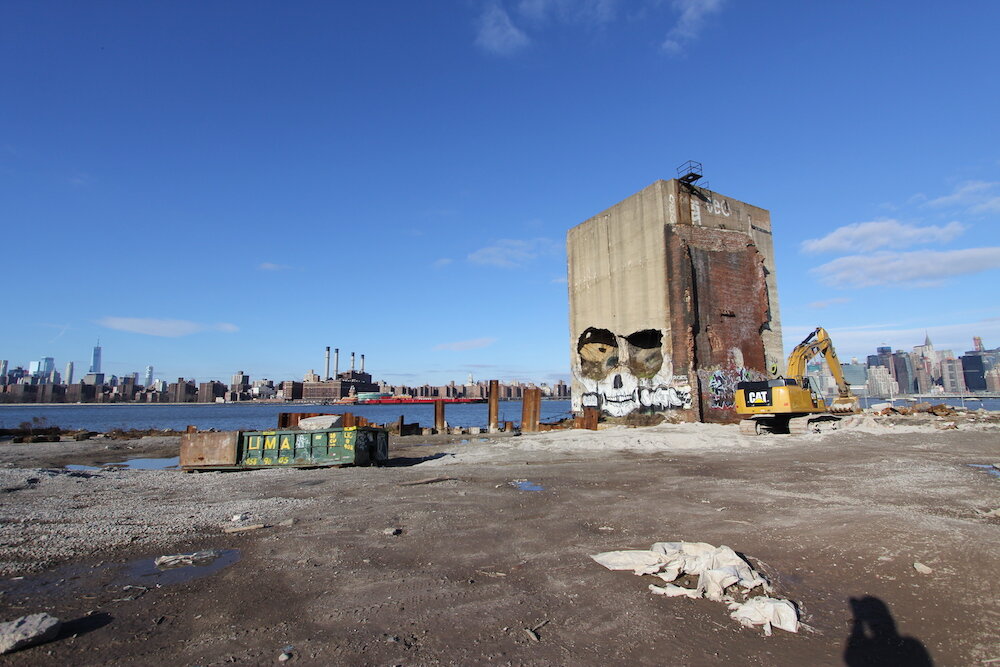
Today, this silo-like building at the end of Oak Street sits idly overlooking the East River. It is one of the few remaining buildings spared by the terminal market fire. On its southern facade, two massive holes are gouged from its brick and concrete structure. Sometime in 2017, a street artist named Greg Suits (@suitswon on Instagram) transformed this decaying building into a life-sized art installation by painting teeth and a jaw bone around the holes, using them as eyes. Skull silo was born!
I visited this site at the end of 2018. It’s clear that construction crews were clearing the lot for something. Despite that, the silo appeared untouched. I see the skull as an allegory to the very history and cultural significance that was lost at this site. Skull silo bears an ominous grin as if it knows the true story behind the very fire that birthed it.
Sources
Flock, E. (2013, December 31). Remembering the ‘Forgotten City,’ Greenpoint Terminal Market.
Bedford & Bowery. https://bedfordandbowery.com/2013/12/remembering-the-forgotten-city-greenpoint-terminal-market/
Hamilton, B. (2006, May 7). Fickle Wind Saved B’klyn,; Inside FDNY’s Inferno Drama
New York Post. https://nypost.com/2006/05/07/fickle-wind-saved-bklyn-inside-fdnys-inferno-drama/
Jacobson, M. (2006, September 14). Brooklyn is Burning. New York Magazine.
https://nymag.com/realestate/features/21339/
Uniformed Firefighters Association. (2006, January 31).
For the Record. https://www.ufanyc.org/cms/contents/view/3328
U.S. Fire Administration/Technical Report Series. (1995, August).
St. George Hotel Complex 16-Alarm Fire. https://www.usfa.fema.gov/downloads/pdf/publications/tr-108.pdf

A Zoo That Was
About two and a half hours from New York City, up the Thruway to Exit 20 and off State Route 32 lies what was once the first privately owned zoo in the U.S. - the Catskill Game Farm.
About two and a half hours from New York City, up the Thruway to Exit 20 and off State Route 32 lies what was once the first privately owned zoo in the U.S. - the Catskill Game Farm. Founded in 1933 by Roland Lindemann, the zoo grew from a single enclosure with a small variety of deer to a 1,000 acre farm with 2,000 animals from all over the world. The game farm peaked in the 1960s, drawing half a million visitors each season. For decades, families would travel from near and far to visit the rural gem. Its primary attraction was the animal nursery and feeding ground where visitors were able to pet, feed, and interact with a variety of quadrupeds including deer, goats, and llamas.

I had visited it several times as a kid. While going through old pictures, I found that I had last been there at seven. Now at 32, visiting the game farm well after its closing, I was nostalgic just as much now as I was then. The reasons for my feelings were different though. As a child, I enamored with the idea of seeing animals not native to the U.S. I had read about them in books and visiting them up close turned the intangible, tangible. Revisiting the zoo 13 years after its closing and 25 years since my last visit, I was curious to see how far gone it had become.
When I pulled into the main lot of the Game Farm, the red admissions booth brought back the same excitement I had felt years ago. Once inside, the cages and pens seemed much smaller than from what I remembered. It was such a contrast from what I had once felt being here. Their emptiness carried an aura of sadness; a stark reminder of how I grew to hate the idea of zoos. Despite the Game Farm once being a magical place for me, I had come to learn that the zoo had its own share of dark secrets.
Prior to the zoo’s closing, Kathie Schultz, the owner of the Game Farm and daughter of Roland Lindemann, received several citations during the annual USDA inspections in 2004 and 2005. They included excess accumulation of manure, poor water drainage, and spoiled food. Finally, in 2006, Schultz was forced to close the doors to the Catskill Game Farm citing years of declining attendance.
The controversy didn’t end there. After the closure, there was considerable concern over the sale of the animals to unlicensed dealers for ‘canned hunts.’ A canned hunt is a trophy hunt where animals are kept in an expansive enclosure making it easier for a hunter to attain a kill. Schultz refused to donate them to sanctuaries leading protestors to picket the zoo. As a result of the press attention, animal advocated pooled their resources to form the Coalition for Catskill Game Farm Animals; the goal being to purchase as many animals as possible at the auction. They targeted the most ‘at risk’ animals including the nilgae, a type of antelope, the aoudad sheep, and two white rhinos. Although many of the animals were saved, several mammals including bison, wisent, a red stag, and other rare antelope, were sold to traders tied to canned hunts.
The property was purchased in 2012 by Ben and Cathy Ballone with the goal of turning the grounds into a campsite. In 2018, renovation work began to turn the old giraffe house into a mini inn. Today, the Ballones open up the grounds to explorers who wish to roam the vast acreage. I took full advantage of this opportunity back in July 2019.
Looking back at the zoo that was once the pride of my childhood, I couldn’t help but reflect on the true story behind what was once a magical place. There was such a contrast to the joy I once experienced as a child to the sadness I felt as an adult being on the grounds.

Blog
Tales from explorations across the U.S.
About two and a half hours from New York City, up the Thruway to Exit 20 and off State Route 32 lies what was once the first privately owned zoo in the U.S. - the Catskill Game Farm.